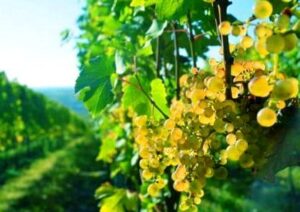
Riesling
Riesling is a light-skinned aromatic (wines with a fruity and floral aroma) grape of German origin. The origins of the grape can be traced to the middle Rhine and the lower Mosel in Germany, which happen to be Europe's great wine rivers. Recall in the last article, Piesporter can also be traced to the left bank of the Mosel River.
This same wine is produced in the "New World", notably, the Australian Riesling from Australia's Clare and Eden valleys, New Zealand's South Island regions and the famous ice wines of Canada are made mostly from Riesling grape.
Its floral undertones with a hint of honey creates a versatile wine for pairings from appetizers to desserts, poultry, pork, shellfish and almost anything in between. It possesses a medium-dry sweetness and exhibits a medium body, making it the perfect wine with most foods.
Cabernet Sauvignon
Cabernet Sauvignon (often shortened to 'Cab Sav') is one of the world's most widely recognized red wine grape varieties. It is grown in nearly every major wine producing country. It is often referred to as the 'King of Red Wine Grapes', hailing originally from Bordeaux and which has a significant presence in California's wine producing areas. It is rivaled by its Bordeaux 'Merlot' and its opposite contender, 'Pinot Noir'. Favouring warmer climates, it is most successful in Australia, Chile, South Africa and New Zealand. Although, the powerhouse productions are found in France and Italy. A common question asked relates to the difference between Merlot and Cab Sav. The answer is that they are made from different grapes. Merlot is often described as a softer and more supple wine than the Cab Sav. Cab Sav is described as having a bit more backbone and tannic strength than Merlot. One of the most noted traits of Cabernet Sauvignon is its affinity for oak, either during fermention or in-barrel ageing.
Cab Sav is best paired with red meats, flavourful and heartier (red) pastas, in particular, penne arrabiata, strong-flavoured cheeses and dark chocolates.
References
Sunday, 30 June 2013
Wednesday, 8 May 2013
Wines of the Month (May)
Gewürztraminer - Australia
This aromatic wine grape variety, despite having a pink to red skin colour creates a white wine possessing a gentle spicy and rose petal aromatic experience. The variety has high natural sugar and the wines are white and usually off-dry, with a flamboyant bouquet of lychees. The name Gewürztraminer literally means "Spice Traminer" or "Perfumed Traminer". Although the species originated in Tramin, Italy, it has been produced from the cooler regions of Australia from the Adelaide Hills, Eden Valley and the island of Tasmania.
Gewürztraminer marries beautifully with rich, fatty dishes like pork and goose or ripe cheeses, as well as with the exotic spices of Moroccan, Indian, and Far Eastern cuisines.
Cabernet / Shiraz - Australia
An interesting blend of the Cabernet grapes variety with Shiraz (Syrah) grape producing a full-bodied wine possessing plenty of dark-fruit flavours with a hint of vanilla oak and spices. This blend coming from Australia keeps the formula as to the proportions under wraps, as this same blend may differ from place to place and season to season.
This bold wine tends to overwhelm light dishes. It is best sipped with red meat dishes, like steak and lamb, heavy cream dishes, and dark chocolate desserts.
References
- Stuart Wilson (1996). Understanding, Choosing, and Enjoying Wine. London: Hermes House. p. 88. ISBN 0-681-18585-6.
- wineaccess.com: Gewürztraminer
- wikipedia: Gewürztraminer
- wikipedia: Syrah
- wine-searcher.com: Cabernet-Syrah
Sunday, 21 April 2013
Wines of the Month (April)
Chardonnay is a green-skinned grape which originates in the Burgundy wine region of eastern France. Its success as the most popular white wine, aside from its attributes, are now grown not only in France, as well as in the USA, Australia, New Zealand and England. This line of grape is popular with wine producers because it produces high yields, and its low maintenance vines will grow in a broad spectrum of climates. The Australian and New Zealand Chardonnays are noted for their butterscotch and golden syrup flavours. In addition, Chardonnays boast an impressive range of flavours from the expected buttered, oak overtones to the fruity flavours of apple, pear, melon which creates a lasting palate impression.
Chardonnay will pair well with poultry dishes, pork or seafood, especially with Digby scallops. Recipes which have a heavy cream or butter base will also pair well.
Cabernet Sauvignon
Cabernet Sauvignon (often shortened to 'Cab Sav') is one of the world's most widely recognized red wine grape varieties. It is grown in nearly every major wine producing country. It is often referred to as the 'King of Red Wine Grapes', hailing originally from Bordeaux and which has a significant presence in California's wine producing areas. It is rivaled by its Bordeaux 'Merlot' and its opposite contender, 'Pinot Noir'. Favouring warmer climates, it is most successful in Australia, Chile, South Africa and New Zealand. Although, the powerhouse productions are found in France and Italy. A common question asked relates to the difference between Merlot and Cab Sav. The answer is that they are made from different grapes. Merlot is often described as a softer and more supple wine than the Cab Sav. Cab Sav is described as having a bit more backbone and tannic strength than Merlot. One of the most noted traits of Cabernet Sauvignon is its affinity for oak, either during fermention or in-barrel ageing.
Cab Sav is best paired with red meats, flavourful and heartier (red) pastas, in particular, penne arrabiata, strong-flavoured cheeses and dark chocolates.
References
- wine-searcher: Chardonnay
- wine-searcher: Cabernet Sauvignon
- wikipedia: Chardonnay
- wikipedia: Cabernet Sauvignon
- about.com: Chardonnay
Sunday, 3 March 2013
Wines of the Month (March)
Riesling
Riesling is a light-skinned aromatic (wines with a fruity and floral aroma) grape of German origin. The origins of the grape can be traced to the middle Rhine and the lower Mosel in Germany, which happen to be Europe's great wine rivers. Recall in the last article, Piesporter can also be traced to the left bank of the Mosel River.
This same wine is produced in the "New World", notably, the Australian Riesling from Australia's Clare and Eden valleys, New Zealand's South Island regions and the famous ice wines of Canada are made mostly from Riesling grape.
Its floral undertones with a hint of honey creates a versatile wine for pairings from appetizers to desserts, poultry, pork, shellfish and almost anything in between. It possesses a medium-dry sweetness and exhibits a medium body, making it the perfect wine with most foods.
Chianti
The name "Chianti" is synonymous of excellent wine world-wide. The origin of Chianti are the gentle hills located in the famous wine region of Tuscanny, between Florence, Siena and Arezzo. The region was rich of forests, water and game had the characteristics of the highlands, and was not easily accessible, preserving the region from the destruction of barbarian invasions after the fall of the Roman Empire. However, during the medieval period, Chianti was the centre of civil wars between Siena and Florence, each of whom wanted control over these lands. Many castles and fortresses in this area bear testimony to this difficult period of its history. Some time after this period of warfare, some of the valleys were cleared and cultivated and which continue to produce the grapes today.
Today, there are at least seven zones defined by the Dalmasso Commission in 1932 which include Chitani Classico, Chianti Montalbano, Chianti Rufini, etc. Its primary red grapes are of the Sangiovese and Canaiolo lines, whereas, the whites are Trebbiano and Malvasia.
This Tuscan treasure charms with bold, rich cherry fruit aromas and flavours of cocoa, vanila and ripe cranberries. Good tannis and a hint of oak make it a soft, balanced red.
References:
Riesling is a light-skinned aromatic (wines with a fruity and floral aroma) grape of German origin. The origins of the grape can be traced to the middle Rhine and the lower Mosel in Germany, which happen to be Europe's great wine rivers. Recall in the last article, Piesporter can also be traced to the left bank of the Mosel River.
This same wine is produced in the "New World", notably, the Australian Riesling from Australia's Clare and Eden valleys, New Zealand's South Island regions and the famous ice wines of Canada are made mostly from Riesling grape.
Its floral undertones with a hint of honey creates a versatile wine for pairings from appetizers to desserts, poultry, pork, shellfish and almost anything in between. It possesses a medium-dry sweetness and exhibits a medium body, making it the perfect wine with most foods.
Chianti
![]() |
| Rolling hills of Chianti |
Today, there are at least seven zones defined by the Dalmasso Commission in 1932 which include Chitani Classico, Chianti Montalbano, Chianti Rufini, etc. Its primary red grapes are of the Sangiovese and Canaiolo lines, whereas, the whites are Trebbiano and Malvasia.
This Tuscan treasure charms with bold, rich cherry fruit aromas and flavours of cocoa, vanila and ripe cranberries. Good tannis and a hint of oak make it a soft, balanced red.
References:
Saturday, 26 January 2013
Wines of the Month (February)
Piesporter
The grapes used to produce these kits were grown in California whose lineage of the grapes were originally sourced from the area around the community of Piesport on the left bank of the Mosel River in Germany. Interestingly, a large Roman grape pressing facility was unearthed at the Piesporter Goldtröpfchen vineyard site in 1985. This discovery clearly indicates the importance of the vines cultivated on the slopes of Piesporter since 3 A.D. The Romans recognized that the Mosel region provided ideal conditions and micro-climate for a successful viticulture. The slope with its east and west facing foothills, are well-protected from the cold winds, combined with the forest above the vineyards and deep, clayish slate soils ensure perfect water supply even during hot, dry summers.
The white wines produced possess a natural, fruity sweetness in a presentation that one can fully enjoy a wine's fruitiness and armoas without having the slightest impression of an overly sweet wine. The natural sweetness is achieved by stopping the fermentation thus preserving the pure and complete expression of the fruit from their respective sites from the region.
Vieux Château du Roi (Château Neuf Du Pape)
The name roughly translated is "old house of the king". Vieux Château du Roi or VCR is a name that wine kits makers' use to represent Château Neuf Du Pape ("new house of the pope") like wine blends. The original name was coined from the time when Pope Clement V moved to Avignon in 1305 due to a conflict between the Papacy and the French Crown in the historic region in the southern Rhone Valley in France. Apparently, the Pope was an avid wine lover. Aside from being infatuated with wine, Pope Clement V's other memorable historical note was that he was ultimately responsible for suppressing the order of the Knights Templar. Getting back to the subject of wine, in California, VCR is produced from a blending of a variety of grapes to imitate the complexities possessed by the original Château Neuf Du Pape. Such attributes as the ripeness of the grapes and the oak barrels used in ageing the red wine creates a lush wine with a polished texture.
References
![]() | ||
| Map depicting Piesport and the surrounding area |
The white wines produced possess a natural, fruity sweetness in a presentation that one can fully enjoy a wine's fruitiness and armoas without having the slightest impression of an overly sweet wine. The natural sweetness is achieved by stopping the fermentation thus preserving the pure and complete expression of the fruit from their respective sites from the region.
Vieux Château du Roi (Château Neuf Du Pape)
| Vineyards located at Château Neuf Du Pape |
References
Monday, 21 January 2013
The Dexter Decision: Action or Inaction on NSLC versus u-vint operators.
The NDP Government, led by our Premier, Darrell Dexter, has a choice to make this week. They have to choose whether or not to intervene in the NSLC’s request to the NS Supreme Court for a permanent injunction to close three small u-vint businesses. And it is a choice. This is not a criminal matter before the courts, it is a civil one. No charges have been laid by the RCMP; no Crown Attorney is handling the application to the court. But someone is making this move forward, and making decisions about how we were investigated, how and when to prosecute us, and how to best force us out of the market. Who ever that is, works for the NSLC. And the NSLC comes under the responsibility of the Department of Finance.
Minister Maureen MacDonald, has the choice to exercise ministerial discretion over this matter. She is not obligated to intervene, but as a senior member of government, it is her responsibility to act in a fair and reasonable manner. She can choose to consider just the regulations and ignore the inherent conflict of interest that exists in having the NSLC be both monopoly retailer and market regulator.
The Premier and all his Ministers can choose to consider the impact this has on three businesses that have been charged and how the business environment in the province is affected.
Actions Needed
Should the Minister and Premier decide to act, versus sit this out to see what happens in a court next Monday, there are things they can do.
- Have the NSLC withdraw their application to the court;
- Have the NSLC cease any further legal action against u-vint operators until such time as the regulations and role of the NSLC in enforcement has been reviewed;
- Order a review of the legislation and regulations in light of both public policy interests and public opinion. Work with industry participants, NSLC management and government representatives to establish clear rules and practises for the operation of u-vint services in Nova Scotia.
Sunday, 20 January 2013
Voice of the People | January 20, 2013
More extracts from The Chronicle Herald, Voice of the People section, Jan 20, 2013 on the subject of small business in NS and the NSLC.
David Beresford-Green, Fall River : NSTC next?
Perhaps one reason for originally
setting up the liquor corporation was to save the poor, ignorant
populace from that pernicious substance called alcohol. But one has
to wonder why there was never any government control over an even
nastier substance called tobacco.
Maybe Darrell Dexter is even now
considering setting up Nova Scotia Tobacco Corporation, with only its
outlets selling the product. I doubt he is, but on that basis
consider the illogicality of the NSLC.
It should not be the government’s
business to sell booze. The NSLC should be privatized and the
province allowed to claw its way into the 21st century.
Kevin MacPherson, Halifax
: Truly,
taxpayers lose
The old Latin expression “in vino
veritas” (in wine there is truth) causes me to write concerning the
great broohaha brewed up by the Nova Scotia Liquor Corporation and
others. The simple truth is that the NSLC is afraid a small dent
might be made in its fiscal bottom line.
I am a senior taxpaying citizen of Nova
Scotia. When I lived in my own home, I made wine as a hobby. Having
moved to an apartment, I no longer have the space to brew my own
“nectar of the gods.” I now rely on a young businessman to make
my wine for me.
It is small businesses and bright young
businessmen and women who are the backbone of economic advances.
These people generate ideas which turn small adventures into
profitable employment for themselves and others. This provides tax
dollars for the government to judiciously use for services to Nova
Scotians.
Should the NSLC fight these small
businessmen in court, it will use taxpayers’ money to pay high-end
lawyers against the minimal funds of the small businessmen. A David
and Goliath struggle which favours the fiscal giant know as the
NSLC.
The losers in this scenario are the
taxpayers of Nova Scotia, for we would discourage other entrepreneurs
from attempting to start small businesses. We would lose more of our
tax base in an already tax-strapped province. And we would lose a
source of excellent wine at an affordable price!
Tim Olive, Dartmouth
: Win-win
scenario
Governments in Nova Scotia continue to
ignore the need to privatize the NSLC. The recent harassment of wine
store businesses is another example of why no government agency can
operate retail businesses as efficiently as the private sector.
Privatization means removal of 90 per
cent of NSLC employees from the tax roll, creation of a new revenue
source through small business taxes, retention of liquor tax revenue
based on distribution of alcohol from a government warehouse to
private-sector businesses, and elimination of all government-owned
and -leased properties related to the NSLC monopoly. In addition, the
private sector would move forward with interprovincial trade and
co-operation in liquor distribution.
What part of the scenario that includes
drastically reduced overhead while retaining tax revenue do civil
servants and politicians not understand? Employees can continue
working in a more realistic private-sector environment and if they
choose not to, opportunities will grow for increased employment of
those looking for work.
Safety, security, age checks for
purchasers or easier access to alcohol are red herrings promoted by
people with a personal interest in continuing NSLC and union
benefits.
Wayne Myers, Dartmouth
: Beating up
little guy
This is another example of the Dexter
NDP government and his minister beating up the little guy. If it was
a larger employer, they would attend a news conference with their
money bag.
The minister should support these small
investors and companies, not have their conflict-of-interest NSLC
beat them up and put jobs on the line — for what? The small amount
of business the NSLC might get?
They should have better things to do
with their high-end, high-priced and highly taxed products than beat
on a few small business outlets and their employees. Oh well, the
minister said it is not a high-priority item on her list — must go
find a mill we can help.
Subscribe to:
Posts (Atom)